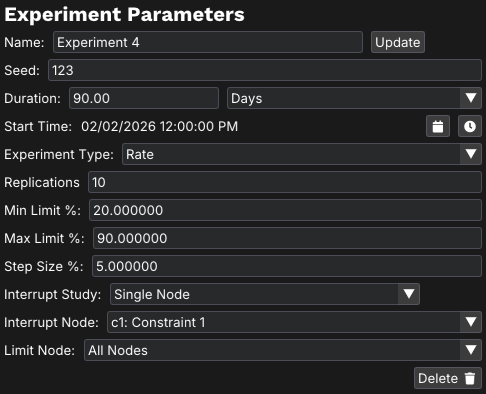
Experiments in ReliaSim provide a structured way to explore how changes in operating conditions affect system performance. Rather than relying on a single outcome, experiments allow you to evaluate different scenarios, quantify variability, and identify where improvements will have the greatest impact. By running targeted experiments, you can move beyond static assumptions and begin understanding how flow behaves over time in the presence of constraints, buffers, rate limits, and interruptions.
A Single Run experiment simulates your system once using a specific set of parameters, making it ideal for establishing baseline performance and observing detailed behavior over a defined time period. Multi Run experiments repeat that same scenario multiple times with different random seeds, helping you understand variability and assess how sensitive your results are to randomness and operational uncertainty. The Buffer Tradeoff experiment focuses on storage capacity, allowing you to test how increasing or decreasing a specific buffer influences throughput and overall performance. Rate experiments examine how changes to processing or constraint rates affect efficiency and production, making them useful for evaluating alternative operating speeds or equipment capabilities. Finally, Gain/Loss experiments isolate the impact of interruptions, revealing which downtime sources most strongly affect the system—often highlighting improvement opportunities that are not immediately obvious from day-to-day operation.
Together, these experiment types allow you to establish baselines, explore variability, test capacity and rate assumptions, and prioritize improvement efforts based on measurable system behavior rather than intuition alone.
A full table of experiment parameters is available, discussing the variables that can be changed within experiments and their uses.